Compare QR/NFC return tags, Bluetooth trackers, RFID labels, and GPS devices for keys, bags, wallets, luggage, and everyday equipment.
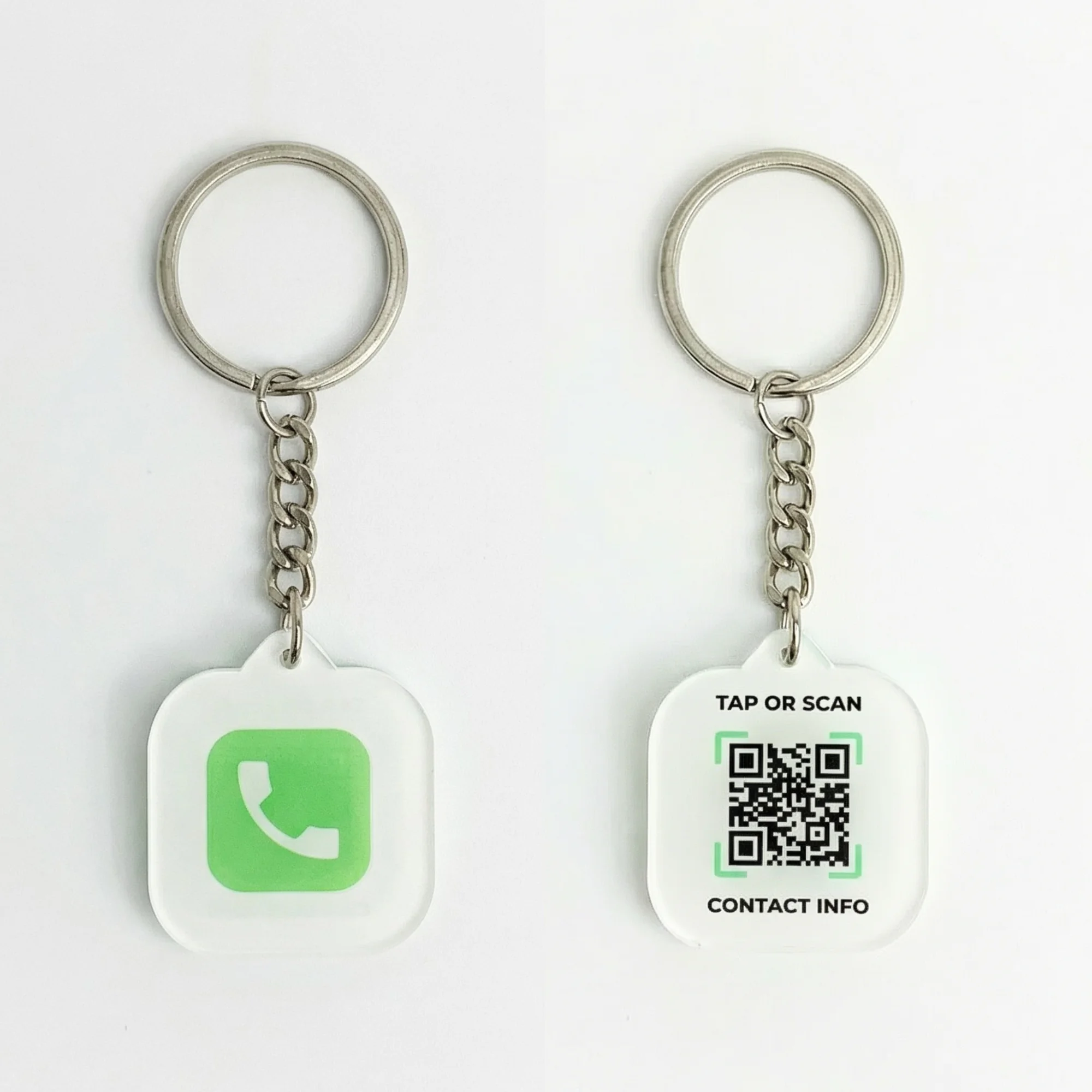
No app download. No sign-up for the finder. Just tag, scan, and connect.
Clip the tag to your keys, bag, wallet, or luggage. It weighs 12 grams and fits anywhere.
They tap the NFC chip or scan the QR code. A page opens with your contact details.
One tap to call or WhatsApp you. You get their live location so you know where your item is.
An asset tag works on anything you carry, wear, or leave behind.
The most commonly lost item in India. A tag on your keyring means any finder can reach you in seconds.
Slip the tag inside or clip to the zipper. If someone picks it up at a restaurant or in a cab, they know who to call.
Airports, train stations, cabs. A visible tag on your bag handle gets it back to you faster than any lost-and-found desk.
See luggage tags →Tag expensive equipment bags. A finder sees your number, not just a blank bag.
Riders leave helmets at parking spots. A tag on the helmet means anyone who picks it up can reach you.
See rider tags →Left a gym bag in the locker room? If someone finds it, they scan the tag and call you instead of handing it to a front desk that may never check.
Small items that get left behind constantly. A tag turns "lost at the cafe" into "called back in 5 minutes."
Expensive, irreplaceable, and often left at venues. A tag on a camera bag or guitar case gives the finder a direct line to you.
No tech complexity. No subscriptions. A tag that simply works.
Unlike Bluetooth trackers, asset tags never die. The NFC chip is powered by the phone that reads it.
Trackers only help when the item is within Bluetooth range. An asset tag works no matter how far the item has traveled — as long as a human finds it.
AirTag needs Apple. Tile needs Tile. JioTag needs Jio. An NFC tag works with any phone.
Set it once. Works for years. No firmware updates, no battery swaps, no app subscriptions.
Shows last known location on a map. Requires battery replacement every 6–12 months. Works only within one ecosystem (Apple Find My, Tile network, JioThings). Monthly range: 10–30 meters (Bluetooth) or continuous (GPS with cellular).
No battery, no app, no ecosystem. Anyone with a phone taps or scans to see your contact info. Works on any phone, anywhere, indefinitely. Best for items likely to be found by people: keys on a table, bags in a cab, wallets at a counter.
Tracker for search. Tag for return.
Together, your items always come home.
LessWorry is the contact layer. Pair it with a tracker for complete coverage.
Every year, Indian Railways' Central Railway zone alone returns approximately 5,000 items through its lost-and-found system at stations like Mumbai CSMT. That sounds like a lot — until you consider that the number of items actually lost on trains is many times higher. Most items never make it to a lost-and-found counter because there is no identification on them. A phone charger left under a seat, a pair of headphones in the seat pocket, a wallet on the platform bench — without a name or number, these items sit unclaimed until they are disposed of or auctioned. The same pattern repeats at airports, hotels, auto-rickshaws, and cabs across the country. The item is found. The finder has no way to reach the owner. The item stays lost.
Passive identification solves this more effectively than active tracking for most everyday items. A Bluetooth tracker like AirTag or Tile relies on a network of nearby smartphones running the same app to relay the item's location. This works well in dense urban areas where many iPhones are passing by, but it breaks down in smaller towns, rural areas, or inside buildings with limited foot traffic. More importantly, trackers help you search for your item — they do not help a willing finder return it. The majority of lost items are recovered because a person physically picks them up, not because a network pinged a location on a map. A visible tag with your contact details turns that moment of pickup into a moment of contact.
Think of it as the three-minute rule. A tagged item is contactable within three minutes of being found. The finder taps the NFC chip or scans the QR code, a page loads, they press Call or WhatsApp, and the conversation starts. An untagged item, by contrast, enters a lost-and-found queue that may never be checked. At a large airport, that queue could be hundreds of items long. At a restaurant, the item might sit in a drawer for weeks before being discarded. In a cab, the driver may have no way to identify the passenger. Three minutes versus three weeks, or never — that is the difference a tag makes.
LessWorry tags use both NFC and QR to cover the widest possible range of phones and scenarios. NFC is faster: a one-second tap with the finder's phone opens the contact page instantly. It works through cases and does not require the finder to open a camera app. QR is the fallback for phones with NFC disabled or older devices that lack NFC support. The finder simply points their phone camera at the printed QR code. Both methods open the same browser-based contact page. No app to install. No account to create. The entire interaction takes under a minute, which matters because the window of goodwill — the time a finder is willing to spend helping — is short.
Privacy is built into the system. The physical tag itself stores only a URL — no personal data is written to the NFC chip. Your name, phone number, emergency contacts, and medical notes are stored securely on the server and displayed only when someone scans the tag. You control exactly which fields are visible. You can change your phone number, update your emergency contact, or add medical information at any time through a browser. All changes are protected by OTP verification so no one else can edit your profile. If you sell or give away the tagged item, you can deactivate the tag with one tap.
Bluetooth asset tracking tags are useful when you want to search for your own item on a map. GPS tracking devices are better for vehicles, fleets, and expensive assets that need live location, but they need charging or a SIM plan. RFID asset tags and labels work well inside warehouses where staff have readers and inventory systems. QR and NFC asset tags are different: they are for human-assisted return. When a cab driver, station staff member, hotel desk, or stranger finds your item, the visible tag gives them a direct way to call or WhatsApp you.
For everyday personal items in India, the practical answer is often a combination. Put a Bluetooth tracker inside the bag if you want map search. Put a LessWorry QR + NFC tag outside the bag, on the keyring, or on the luggage handle so the finder can reach you immediately.
Starts at ₹299. Packs of 2 and 4 available. Free shipping across India.
Buy LessWorry₹299 to never wonder if a lost item will come back.
